
A voltage-to-current converter, also called a V-to-I converter or transconductance amplifier, produces an output current that changes in proportion to an input voltage.
The basic relationship is:
Iout = Vin / R
Here, R sets the conversion scale. For example, with a 1 kΩ setting resistor, a 1 V input ideally produces 1 mA of output current.
Real circuits have limits. The output current can stay proportional to the input only while the amplifier has enough supply voltage and output-current capacity to drive the load.
Why convert voltage to current?
Some sensors and control systems represent information as current. A converter can take a voltage from a sensor or control circuit and produce a corresponding current for a load or measurement system.
Current signaling can be useful when the receiving circuit is separated from the source, but it is not automatically immune to noise. The results depend on the wiring, circuit design, and measurement equipment.
A simple resistor circuit
A voltage source connected through a resistor produces current according to Ohm’s law. If the load is in series with that resistor, however, the current is:
I = Vin / (R + RL)
where RL is the load resistance. The current changes if the load changes, so this simple passive circuit does not behave like a constant-current source.
Op-amp voltage-to-current converter with a floating load
One basic active circuit uses an op amp and a resistor to set the current. The load is placed in the feedback path and does not have to connect to ground, so it is called a floating-load converter.
In the ideal case, the op amp’s feedback keeps the voltage across the setting resistor equal to the input voltage. The current through that resistor is therefore Vin/R. Because very little current enters the op amp input, approximately the same current flows through the load.
This circuit can drive resistive or other loads, but only within the amplifier’s output-voltage, output-current, and stability limits. A capacitive load, for example, may require careful circuit design to avoid instability.
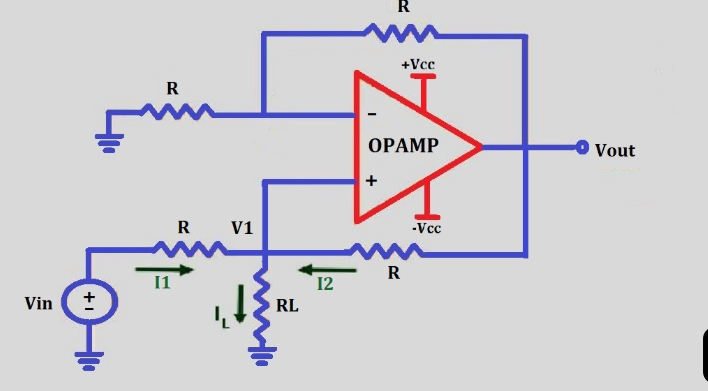
Grounded-load converter: the Howland current pump
A Howland current pump is an op-amp circuit designed to drive a load connected to ground. Its resistor network sets the relationship between input voltage and output current.
The Howland circuit depends on accurate resistor ratios. Mismatch can make the output current vary with load resistance, reducing its usefulness as a current source. The op amp also needs enough voltage range to support the load and enough output current for the application. (TI: Howland current-pump design, Analog Devices: Grounded-load current-source resistor matching)
Choosing a V-to-I converter
Before building or selecting a converter, determine:
- The input-voltage range and the current you want it to produce.
- The load’s resistance or operating range.
- Whether one side of the load must connect to ground.
- The supply voltages available to the op amp.
- The required current accuracy and resistor tolerance.
- The op amp’s output-current, voltage-swing, and stability limits.
A converter cannot maintain the requested current if the output voltage needed by the load exceeds what the amplifier can provide. This limit is often described as the circuit’s compliance voltage.
Applications
Voltage-to-current converters are used in:
- Sensor and control circuits: Convert a voltage measurement into a current command.
- Current sources and sinks: Drive a load with a current set by a voltage.
- Component testing: Supply controlled current when testing LEDs, diodes, and other components.
- Signal interfaces: Convert voltage signals for current-loop systems. A standard 4–20 mA interface has additional requirements, so it needs a circuit designed for that protocol.
For precision or wide load ranges, component choice and feedback design matter. Texas Instruments’ Howland current-pump reference design shows one implementation and its operating range. (TI: Improved Howland current pump)
Key points
A voltage-to-current converter makes output current proportional to an input voltage. A resistor-only circuit is simple, but its current changes with the load. Op-amp circuits can provide better control: a floating-load design suits loads that need not be grounded, while a Howland current pump is designed for grounded loads. In either case, the current is limited by the circuit’s resistor accuracy, supply voltage, output capability, and load.