
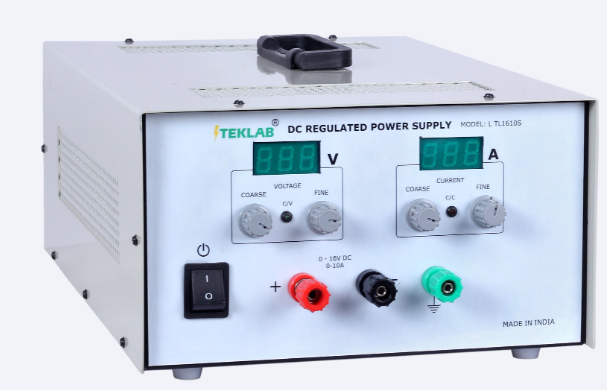
A regulated power supply provides an output voltage that stays within a specified range as the input voltage or load changes. Many supplies convert AC mains power into regulated DC, but regulated supplies can also take DC input, as battery-powered converters do.
A traditional linear supply often uses a transformer, rectifier, filter, and regulator. That is one common design, but a regulated power supply is not necessarily a linear supply: switching supplies also regulate voltage.
The main stages in a traditional AC-to-DC supply
1. Transformer
In an isolated linear supply, a transformer changes the AC mains voltage to a lower AC voltage suitable for the circuit. Transformer output voltage, current rating, and insulation must match the design.
Some modern supplies use switching converters and do not follow this exact transformer-first arrangement.
2. Rectifier
A rectifier uses diodes to convert AC into pulsating DC. A bridge rectifier uses four diodes so both halves of the AC waveform contribute to the output. The output is unidirectional, but it still rises and falls instead of remaining perfectly steady.
3. Filter
A filter smooths the rectifier’s pulsating output. A capacitor filter charges near the waveform peaks and then discharges into the load between peaks. This reduces, but does not eliminate, the remaining variation, called ripple.
Other designs may use inductors and capacitors together. The amount of ripple depends on the circuit, load current, mains frequency, and component values. A filter capacitor that is too small may let the voltage fall below the regulator’s minimum input requirement. (Analog Devices: Rectifiers, filters, and regulators)
4. Voltage regulator
The regulator holds the output near its target despite changes in input or load, as long as those changes remain within the regulator’s operating limits. It may also provide features such as current limiting or thermal protection, depending on the device.
Fixed regulators such as the 7805 family provide a set output voltage. Adjustable regulators such as the LM317 use external resistors to set the output. For the LM317, the output voltage is approximately:
Vout = 1.25 V × (1 + R2/R1) + Iadj × R2
Use the values and recommended circuit from the specific regulator’s datasheet. Capacitor requirements also vary by device and circuit; there is no single universal input or output capacitor value. (TI: LM317 datasheet, TI: 7805 family datasheet)
Linear and switching regulated supplies
Linear supply
A linear regulator controls a pass transistor so it drops the difference between the input and output voltages. Linear supplies are often straightforward and can provide low ripple and noise. Their drawback is that the voltage dropped across the regulator becomes heat.
A rough estimate of regulator heat is:
P ≈ (Vin − Vout) × Iout
A linear regulator also needs its input to remain above the output by at least its required dropout voltage. (Analog Devices: Linear and switching power supply basics)
Switching supply
A switching regulator rapidly turns a transistor on and off and uses components such as inductors and capacitors to transfer energy. Depending on its design, it can step voltage down, step it up, or provide an output with a different polarity.
Switching supplies are often more efficient when the voltage change or load current is large. Their switching action can also create ripple and electromagnetic interference, so filtering and layout matter. (Analog Devices: Switching regulator overview)
Why regulation matters
A regulated output helps electronic equipment receive voltage within its specified operating range. Without suitable regulation, changes in the source or load can make the output fall or rise beyond what connected components can tolerate.
A regulator is not a guarantee against every fault. Designers still need to account for maximum input voltage, load current, ripple, startup behavior, temperature, and any required protection features.
Choosing a regulated power supply
Before choosing or designing one, check:
- Input range: AC or DC, minimum and maximum voltage, and frequency if applicable.
- Output requirements: Voltage, continuous current, and startup or peak current.
- Ripple and noise: How much variation the load can tolerate.
- Efficiency and heat: The regulator’s power loss and cooling requirements.
- Isolation: Whether the output must be electrically isolated from the input.
- Datasheet requirements: Required capacitors, thermal limits, protections, and operating conditions.
For supplies connected to mains electricity, use components and enclosures rated for the voltage and follow appropriate electrical safety practices. Mains circuits can cause severe injury or fire.
Key points
A regulated power supply keeps its output within specified limits when the input or load varies within the design range. A traditional linear AC-to-DC supply uses a transformer, rectifier, filter, and regulator; switching supplies use a different conversion method. Choose the design based on the input, output, current, noise, efficiency, thermal, and safety requirements of the application.