
Key points
- Meaning: A bleeder resistor drains the charge stored in a power supply’s capacitors after the equipment is switched off.
- Safety: It helps reduce the risk of electric shock from charged capacitors.
- Choosing a resistor: The resistance must balance how quickly the capacitor discharges with how much power the resistor uses.
- Voltage regulation: In some circuits, a bleeder resistor can help keep the output voltage more stable as the load changes.
- Voltage division: A tapped bleeder resistor can provide several voltage levels for different parts of a circuit.
What Is a Bleeder Resistor?
A bleeder resistor is connected in parallel with the output of a high-voltage power supply. It safely drains the electrical charge stored in the power supply’s filter capacitors after the equipment is switched off.
Capacitors can retain a dangerous charge even when the equipment is off. If someone touches the circuit while servicing it, they could receive an electric shock. The bleeder resistor provides a path for the charge to dissipate, helping reduce that risk.Importance of Bleeder Resistor in a Circuit
To understand the importance of a bleeder resistor, let’s consider a circuit with a filter, like a full-wave rectifier. The rectifier’s output is a pulsating DC signal, not a pure DC signal, and cannot be directly supplied to the load.
A filter circuit smooths the rectifier’s pulsating output to produce a steadier DC voltage. It typically uses capacitors and inductors. The circuit shown connects the rectifier to the load through the filter circuit and bleeder resistor..
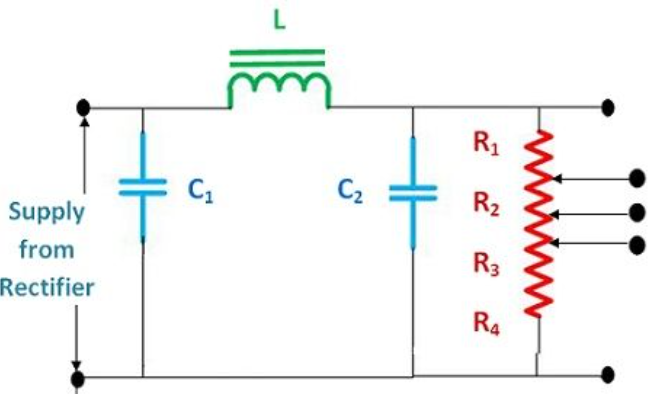
IIn this circuit, the bleeder resistor is connected in parallel with the capacitor. While the device is on, the capacitor charges. When the device is switched off, it may still hold an electrical charge.
Without a bleeder resistor, someone touching the capacitor’s terminals could receive an electric shock as the stored charge discharges through them. With the resistor connected in parallel, the charge has a path to drain through the resistor instead.
How to Choose a Bleeder Resistor
Selecting a small-value resistor allows for high-speed bleeding but consumes more power. Choosing a high-value resistor reduces power loss but slows down the bleeding process.
So, the designer has to select a properly valued resistor that is high enough to not interfere with the power supply and low enough to discharge the capacitor in a short time.
To choose a suitable bleeder resistor, use the relationship between the capacitor’s initial voltage (V_0), its voltage (V_t) after time (t), the resistance (R), and the capacitance (C). These values can be used in the equation below to calculate the required resistance.
For safety, choose a low target voltage for the capacitor after the discharge period. The voltage approaches zero gradually, so reaching exactly zero would take an infinite amount of time. The designer should therefore select a safe target voltage and decide how quickly the capacitor must reach it.
Choosing a low resistance makes the capacitor discharge faster, but it also increases the power dissipated by the resistor. The power calculation uses the initial voltage \(V_0\) and the resistor’s value.
The designer must balance the desired discharge time against the amount of power the resistor will consume.
Applications of Bleeder Resistors
Although bleeder resistors are mainly used to discharge capacitors safely, they can also help regulate voltage and, when tapped, serve as voltage dividers.
Voltage regulation
Voltage regulation describes how much a power supply’s output voltage changes between no-load and full-load conditions. It is calculated as the difference between the no-load voltage and the full-load voltage, divided by the no-load voltage. The equation is shown below.
Where V0 is no-load voltage and Vf is a full-load voltage. For good voltage regulation, the value of Vr is kept as low as possible.
Now if the bleeder resistor is connected in parallel with a filter capacitor and load resistor. Therefore, the voltage drop occurs in load resistance as well as in bleeder resistance.
When supply is given, the voltage drop across the load resistance comes into the picture. But, when supply is OFF, the voltage drop across the bleeder resistance comes into the picture. Hence, it increases the value of the no-load voltage.

Therefore, it will decrease the value of the difference of no-load voltage and full-load voltage that improves the voltage regulation of the circuit.
Voltage Division
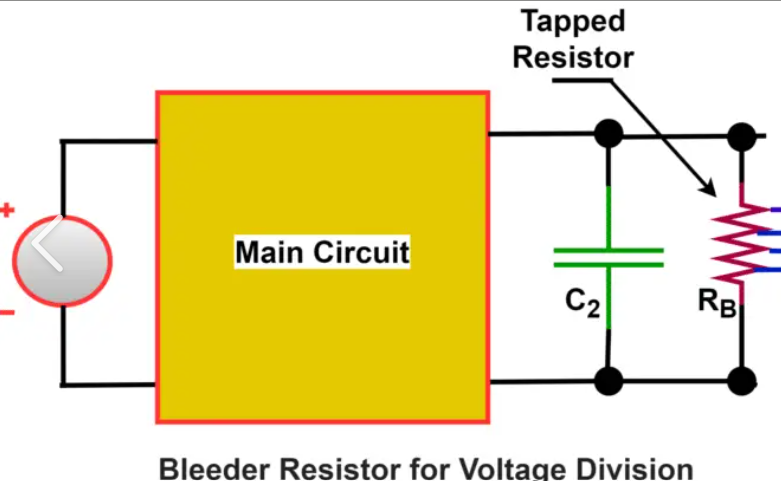
If you want multiple voltage arrangements in your circuit, a tapped resistor is used as a bleeder resistor. The circuit arrangement is as shown in the below figure.
The bleeder resistor shown has three taps. Selecting different tap points provides three voltage levels for the loads, so the resistor also acts as a voltage divider.
Safety
A bleeder resistor’s main purpose is to discharge the capacitor after the equipment is switched off. The figure below shows how it is connected for this purpose.
The filter contains inductors and capacitors. A bleeder resistor is connected in parallel with the filter capacitor. When the device is switched off, the capacitor may still retain some charge.
A charged capacitor can cause an electric shock if it discharges through someone who touches it. Connecting a bleeder resistor in parallel with the capacitor allows the stored charge to drain away after the device is switched off.