
Solution: Thermistor resistance and temperature
Given:
- Resistance at
- Resistance at
- Resistance-temperature relationship:
R_t=R_0e^{bA}
Using the usual thermistor notation, the formula is normally written as
R_t=R_0e^{\beta/T}
where:
- = resistance at temperature
- = reference resistance constant
- = thermistor constant
- = absolute temperature in kelvin (K)
- = exponential constant, approximately
Important: The temperatures must be converted from Celsius to kelvin before using the formula.
T(K)=T(^\circ C)+273
(i) Calculate the thermistor constant
Step 1: Convert temperatures to kelvin.
T_1=25+273=298KT_2=82+273=355K
Step 2: Take the natural logarithm of the formula.
R=R_0e^{\beta/T}
For the two temperatures:
R_1=R_0e^{\beta/T_1}R_2=R_0e^{\beta/T_2}
Divide the equations to eliminate :
\frac{R_1}{R_2}
=e^{\beta(1/T_1-1/T_2)}
Taking natural logarithms:
\ln\left(\frac{R_1}{R_2}\right)
=\beta\left(\frac1{T_1}-\frac1{T_2}\right)
Therefore,
\beta=
\frac{\ln(R_1/R_2)}
{\left(\frac1{T_1}-\frac1{T_2}\right)}
Step 3: Substitute the values.
\beta=
\frac{\ln(27000/490)}
{\left(\frac1{298}-\frac1{355}\right)}\beta=\frac{\ln(55.102)}
{0.003356-0.002817}\beta=\frac{4.009}{0.000539}\boxed{\beta\approx7441\ K}
(ii) Calculate the resistance range from to
Use the formula:
R_t=R_1e^{\beta(1/T-1/T_1)}
We already know:
Step 1: Calculate resistance at
Convert to kelvin:
T=35+273=308K
Substitute:
R_{35}=27000e^{7441(1/308-1/298)}R_{35}=27000e^{-0.810}R_{35}=27000(0.445)\boxed{R_{35}\approx12,003\ \Omega}
Or approximately .
Step 2: Calculate resistance at
Convert to kelvin:
T=85+273=358K
Substitute:
R_{85}=27000e^{7441(1/358-1/298)}R_{85}=27000e^{-4.182}\boxed{R_{85}\approx411\ \Omega}
Final answers
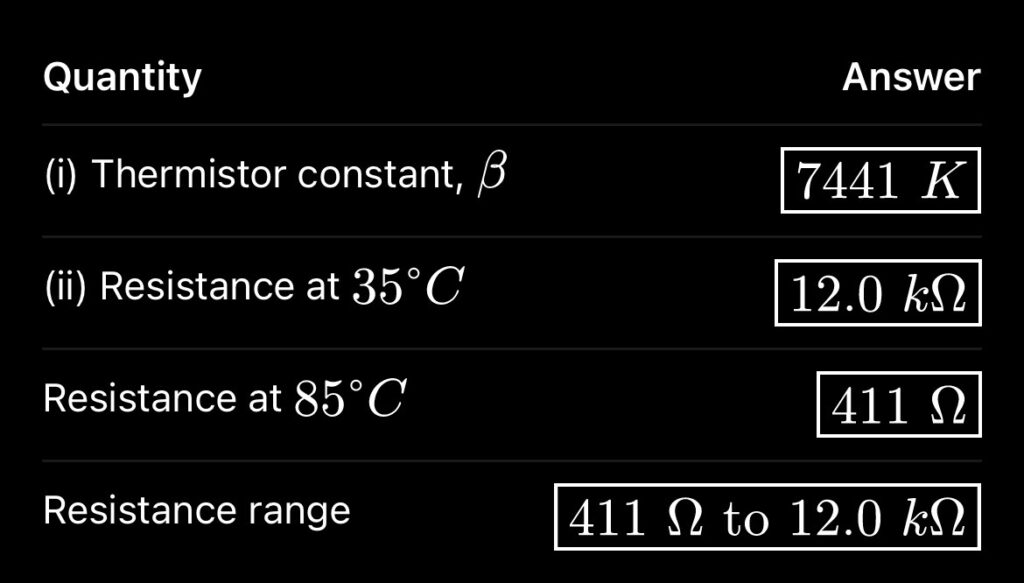
Engineering interpretation: This is an NTC thermistor because its resistance decreases as temperature increases. Therefore, the highest resistance occurs at , while the lowest occurs at .