
A ballast resistor is a component that helps control current in an electrical circuit. It can protect other components from excessive current and, in some designs, help keep current stable as operating conditions change.
The word ballast is also used more broadly for devices that regulate current in lighting systems. A fluorescent lamp ballast, for example, starts the lamp and limits its current while it operates. Some ballasts use electronic circuits rather than a resistor. (U.S. Department of Energy: Fluorescent Lamp Ballasts)
What does a ballast resistor do?
A resistor in series with a load reduces the current flowing through that circuit. Some ballast resistors are fixed: their resistance stays roughly the same during normal operation. Others are designed so their resistance changes with temperature. In those devices, rising current can heat the resistor and increase its resistance, which helps limit further current.
That temperature response is a feature of particular resistor types, not a property of every ballast resistor. A standard fixed resistor does not automatically adjust its resistance to hold current constant.
Common applications
Ballast resistors are most often discussed in connection with older vehicle ignition systems, lamps, and simple circuits that need current limiting.
Older automotive ignition systems
Some older vehicles use an ignition ballast resistor in series with the ignition coil. It reduces the current through the coil while the engine is running, helping the coil operate within its intended range.
In some systems, a separate wire bypasses the resistor while the starter is cranking. This lets the coil receive more voltage during starting, when the battery voltage may drop under the starter’s load. The wiring and voltage depend on the vehicle, so check its service information before testing or replacing components. (Ignition system training resource)
LEDs
An LED needs current limiting. For a simple DC circuit, a series resistor can limit the current:
R = (Vs − Vf) / If
Where:
- R is the resistor value in ohms
- Vs is the supply voltage
- Vf is the LED’s forward voltage
- If is the desired LED current in amperes
For example, suppose a 5 V supply powers an LED with a forward voltage of 3.1 V at 9 mA:
R = (5 − 3.1) / 0.009 ≈ 211 Ω
A standard 220 Ω resistor is a practical choice. It would allow roughly 8.6 mA under those assumptions. The resistor also dissipates about 0.016 W, so a common ¼ W resistor has ample power capacity for this example. Always check the LED’s datasheet and the supply voltage; resistor selection depends on both. Texas Instruments provides further guidance on calculating a series resistor for an LED. (TI: LED current-limiting resistor)
A series resistor is useful for a basic LED circuit, but it is not always the best choice for high-power LEDs or battery-powered products. Those applications commonly use a constant-current driver.
Fluorescent and other discharge lamps
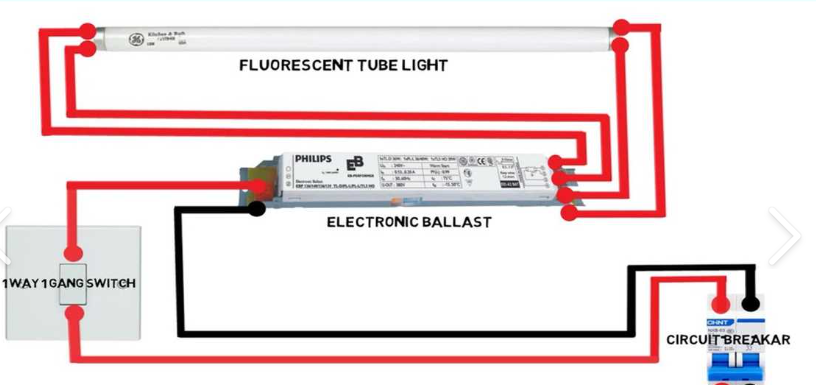
Fluorescent and other discharge lamps need a ballast because their current can rise sharply after the lamp starts. A ballast provides the conditions needed to start the lamp and then limits its operating current. Modern electronic ballasts perform this job with electronic circuitry. (U.S. Department of Energy: Fluorescent Lamp Ballasts)
Types of ballast resistors
Fixed resistor
A fixed ballast resistor has a set resistance. It can limit current in simple circuits or form part of a multi-speed fan circuit, where a switch selects different resistance paths.
Temperature-sensitive resistor
Some ballast resistors use a material whose resistance changes as it heats. In a design with a positive temperature coefficient, resistance rises as temperature increases, helping to reduce current. The exact behavior depends on the component and circuit.
How to test an automotive ballast resistor
A multimeter can help check a resistor, but readings must be compared with the vehicle’s specifications.
- Find the correct specification. Consult the service manual or manufacturer’s information for the expected resistance and test procedure.
- Switch off the ignition. Let hot components cool. If you need to disconnect the resistor, follow the service instructions and isolate the circuit safely.
- Measure resistance. Set the meter to ohms and measure across the resistor terminals. A reading far outside the specified range, or an open circuit, may indicate a failed resistor.
- Check the circuit only if needed. Voltage readings vary by vehicle and by whether the engine is cranking or running. Do not assume a particular coil voltage, such as 7–8 V, is correct for every vehicle.
Resistance checks are best performed with the component isolated from the circuit; other connected components can affect the reading. For vehicle-specific diagnosis, use the service manual or consult a qualified automotive technician.
Key points
A ballast resistor limits current, but its behavior depends on the design. Fixed resistors have a set resistance; temperature-sensitive types can change resistance as they heat. You may encounter ballast resistors in older ignition systems and simple LED circuits, while fluorescent lamps use ballasts that may be electronic. Choose or test any component using the specifications for the circuit it belongs to.