
In an AC circuit, voltage and current vary over time. If they are out of phase, multiplying their RMS values gives apparent power, not necessarily the power converted into useful work or heat. To describe AC power fully, engineers distinguish real power, reactive power, and apparent power.
Instantaneous power and average power
Instantaneous power is the product of voltage and current at a particular moment:
p(t) = v(t) × i(t)
For sinusoidal AC, voltage and current can have a phase difference, φ. The average real power over a cycle is:
P = Vrms × Irms × cos φ
Here cos φ is the power factor for sinusoidal voltage and current. RMS values are used in this formula. (OpenStax: Power in an AC Circuit)
Three AC power quantities
| Quantity | Symbol | Unit | Meaning |
|---|---|---|---|
| Real (active) power | P | watt (W) | Average power transferred to a load and converted into work, heat, light, or another form of energy |
| Reactive power | Q | volt-ampere reactive (var) | Measures energy exchanged between the source and reactive fields in inductors and capacitors |
| Apparent power | |S| | volt-ampere (VA) | Product of RMS voltage and RMS current |
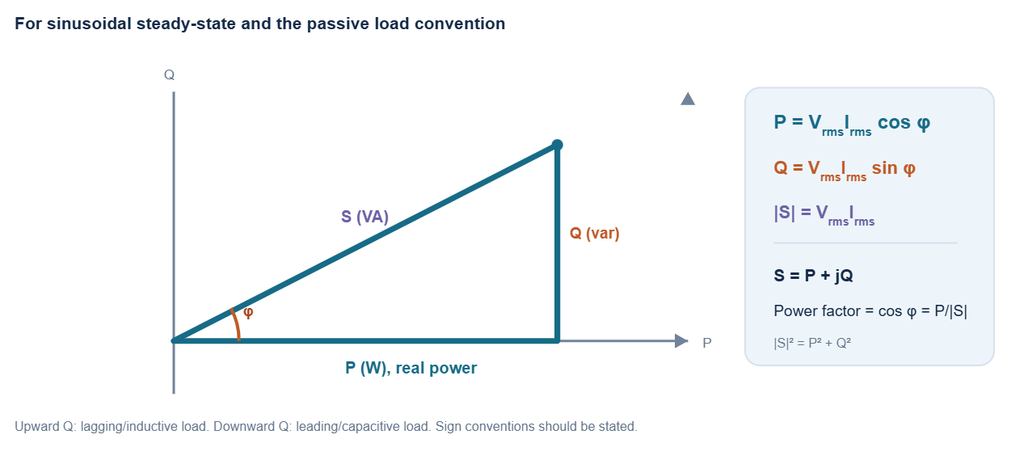
For a sinusoidal load, using the passive load convention:
P = Vrms Irms cos φ
Q = Vrms Irms sin φ
|S| = Vrms Irms
The corresponding complex power is S = P + jQ, and its magnitude follows:
|S|² = P² + Q²
The sign of Q depends on the sign convention. With the common load convention, an inductive load has positive, lagging reactive power; a capacitive load has negative, leading reactive power.
Reactive power does not represent net energy converted over a full cycle in an ideal inductor or capacitor. It describes energy that is stored temporarily in electric or magnetic fields and then returned to the circuit.
Power factor
Power factor indicates how much apparent power corresponds to real power:
Power factor = P / |S| = cos φ
A purely resistive load has voltage and current in phase, so its power factor is 1. With inductive or capacitive loads, the phase difference changes the relationship between real and apparent power. Power factor is not always simply the cosine of one phase angle in circuits with distorted, nonsinusoidal current.
Worked example
A single-phase load operates at 230 V RMS, draws 5 A RMS, and has a 0.8 lagging power factor.
Apparent power:
|S| = 230 × 5 = 1,150 VA
Real power:
P = 1,150 × 0.8 = 920 W
For a sinusoidal load, sin φ = 0.6, so:
Q = 1,150 × 0.6 = 690 var
Thus, the load draws 1,150 VA of apparent power, while 920 W is the average real power it consumes.
How this relates to three-phase power
For a balanced three-phase system, total real power is three times the real power in one phase. Using line-to-line RMS voltage and line current:
Ptotal = √3 × Vline × Iline × cos φ
For an unbalanced system, calculate each phase’s real power and add the results. Three-phase power is not always simply three times a single-phase value. (OpenStax: AC power)
Key points
Real power P is measured in watts, reactive power Q in var, and apparent power |S| in VA. For sinusoidal AC, their relationship depends on the phase angle between voltage and current. State the sign convention when discussing leading or lagging reactive power, and apply the three-times-per-phase rule only to balanced three-phase systems.