
An electronvolt, symbol eV, is a unit of energy used in atomic physics, electronics, optics, and particle physics. Despite its name, it measures energy—not voltage or power.
One electronvolt is the energy change associated with a particle whose charge has magnitude equal to the elementary charge crossing a potential difference of one volt.
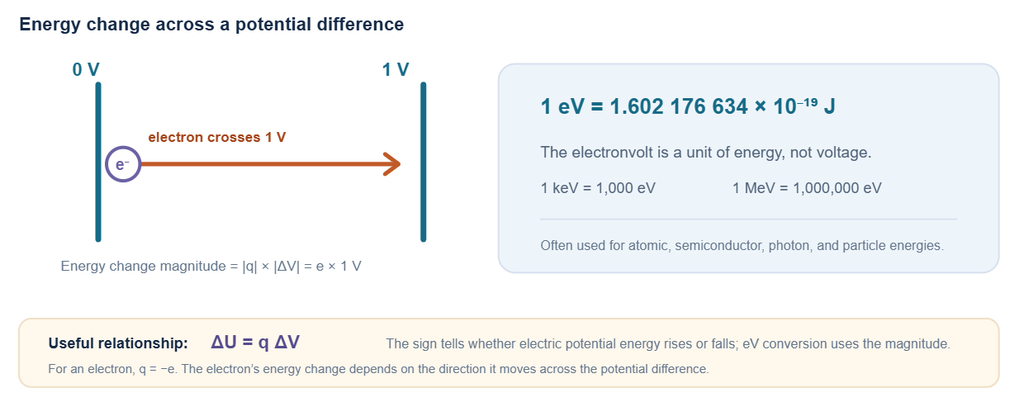
How the electronvolt is defined
Electrical potential difference is energy change per unit charge. For a charge q moving between two points:
ΔU = q × ΔV
where ΔU is the change in electric potential energy, q is the charge, and ΔV is the potential difference.
For a particle with charge magnitude e crossing a potential difference of 1 V, the energy-change magnitude is:
1 eV = e × 1 V
The elementary charge has the exact magnitude 1.602 176 634 × 10⁻¹⁹ coulomb, so:
1 eV = 1.602 176 634 × 10⁻¹⁹ joule
This conversion is exact. (NIST: CODATA fundamental constants; OpenStax: Electric Potential Difference)
Charge direction and energy change
An electron has charge −e, so its potential-energy change is ΔU = −e × ΔV. The sign depends on the direction the electron moves across the potential difference. When an electron accelerates through a potential difference of 1 V in the direction that lowers its electric potential energy, it gains 1 eV of kinetic energy, assuming energy losses are negligible.
The electronvolt itself is a positive unit of energy. It can describe the energy of an electron, another particle, or a photon.
Electronvolt examples
- 1 eV = 1.602 176 634 × 10⁻¹⁹ J
- 5 eV ≈ 8.01 × 10⁻¹⁹ J
- 1 keV = 1,000 eV
- 1 MeV = 1,000,000 eV
For example, a particle with energy 5 eV has energy in joules of:
5 × 1.602 176 634 × 10⁻¹⁹ ≈ 8.01 × 10⁻¹⁹ J
Where electronvolts are used
The joule is the SI unit of energy, but the electronvolt is convenient for very small energies. It is commonly used for:
- Atomic and semiconductor energy levels
- Photon energies, including visible light and X-rays
- Particle physics, often using keV, MeV, or GeV
- Temperature and plasma physics, where particle energies may be described in eV
Power, voltage, and energy are different
Power is the rate of energy transfer. In a circuit, instantaneous power is p = v × i; for a steady DC load, power is P = V × I. Energy transferred over time is power multiplied by time.
These relationships connect electricity to energy, but they describe different quantities:
- Voltage is energy per unit charge.
- Power is energy transferred per unit time.
- Energy can be measured in joules or electronvolts.
Key points
An electronvolt is a unit of energy, with 1 eV exactly equal to 1.602 176 634 × 10⁻¹⁹ J. It represents the magnitude of the energy change for an elementary charge across a 1 V potential difference. The sign and direction of a particle’s actual energy change depend on its charge and direction of travel.