
Key Takeaways
- Electric potential is electric potential energy per unit charge, measured in volts.
- A potential difference tells us how much energy per coulomb changes between two points.
- One volt equals one joule per coulomb: 1 V = 1 J/C.
- For a point charge, potential is V = kQ/r when zero potential is defined at infinity.
- Potential is a property of the electric field; potential energy depends on both the field and the charge placed in it.
What Is Electric Potential?
Electric potential, usually written as V, describes the electric potential energy available per unit charge at a location. More precisely, the potential difference between two points is the change in electric potential energy divided by the charge moved between them.\[ \Delta V = \frac{\Delta U}{q} \]
Here, \(\Delta U\) is the change in potential energy in joules, and \(q\) is the charge in coulombs. This relationship means a potential difference of 1 volt corresponds to a change of 1 joule in energy for each coulomb of charge. OpenStax explains electric potential and potential difference in more detail.
Electric potential is measured relative to a chosen reference point. For an isolated point charge, the reference is commonly set to zero at infinity. In circuit work, ground is often chosen as the zero-voltage reference. The choice of zero is a convention; measurable potential differences are what determine energy changes.
Electric Potential and Potential Difference
Potential at a point describes its value relative to a reference. Potential difference, also called voltage, compares the potential at two points:\[ \Delta V = V_B – V_A \]
If a positive charge of \(1\ \text{C}\) moves from a point at \(5\ \text{V}\) to a point at \(8\ \text{V}\), its potential energy increases by:\[ \Delta U = q\Delta V = (1\ \text{C})(3\ \text{V}) = 3\ \text{J} \]
For a charge \(q\), the energy change is \(\Delta U=q\Delta V\). The work done by an external agent moving the charge slowly equals this energy change. The electric field does the opposite amount of work.
Potential Due to a Point Charge
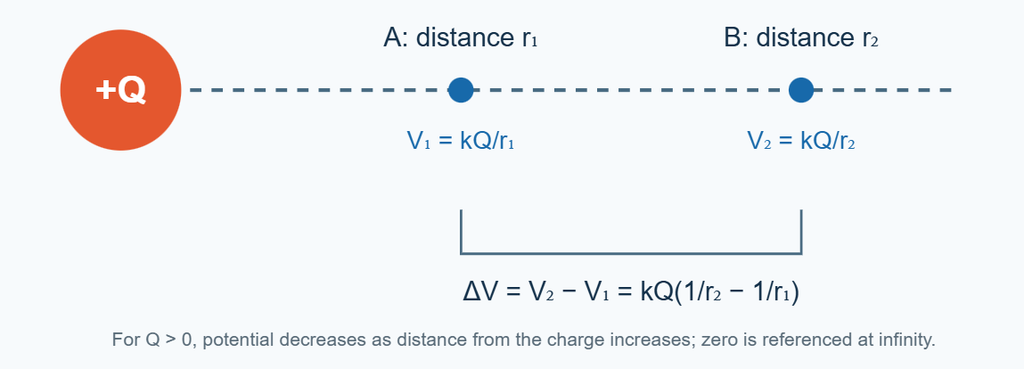
For a point charge \(Q\), the electric potential at distance \(r\), with zero potential at infinity, is:\[ V = \frac{kQ}{r} \]
where:
- \(V\) is electric potential in volts
- \(Q\) is the source charge in coulombs
- \(r\) is the distance from the charge in metres
- \(k \approx 8.99 \times 10^9\ \text{N·m}^2/\text{C}^2\) in vacuum
The sign of \(Q\) determines the sign of the potential: a positive source charge produces positive potential, while a negative source charge produces negative potential. The magnitude gets smaller as the distance from the charge increases. OpenStax provides the point-charge potential formula and worked calculations.
Potential Difference Between Two Points
For points A and B at distances \(r_A\) and \(r_B\) from a point charge \(Q\):\[ V_A = \frac{kQ}{r_A}, \qquad V_B = \frac{kQ}{r_B} \]
Therefore:\[ \Delta V_{AB} = V_B – V_A = kQ\left(\frac{1}{r_B}-\frac{1}{r_A}\right) \]
For example, let \(Q=2\ \mu\text{C}\), \(r_A=0.20\ \text{m}\), and \(r_B=0.50\ \text{m}\). Using \(k \approx 8.99\times10^9\):\[ V_A \approx 89{,}900\ \text{V}, \qquad V_B \approx 35{,}960\ \text{V} \]
So the potential change from A to B is about \(-53{,}940\ \text{V}\). It is negative because point B is farther from the positive source charge and therefore has lower potential.
Electric Potential and Current
A potential difference can drive charge through a circuit, but current also depends on the circuit’s properties, such as resistance. In a metal wire, electrons drift toward higher electric potential, while conventional current is defined in the opposite direction. The actual current in a complete circuit depends on how its components and power source are connected.
Summary
Electric potential measures electric potential energy per unit charge. Its unit, the volt, is equivalent to a joule per coulomb. For a point charge, potential varies as \(kQ/r\), and the difference between two points is found by subtracting their potentials. Remember to state the reference point when giving an absolute potential; in practical circuits, voltage differences are usually the quantities of interest.