
Key Takeaways
- A cyclotron accelerates charged particles using a magnetic field and an alternating electric field.
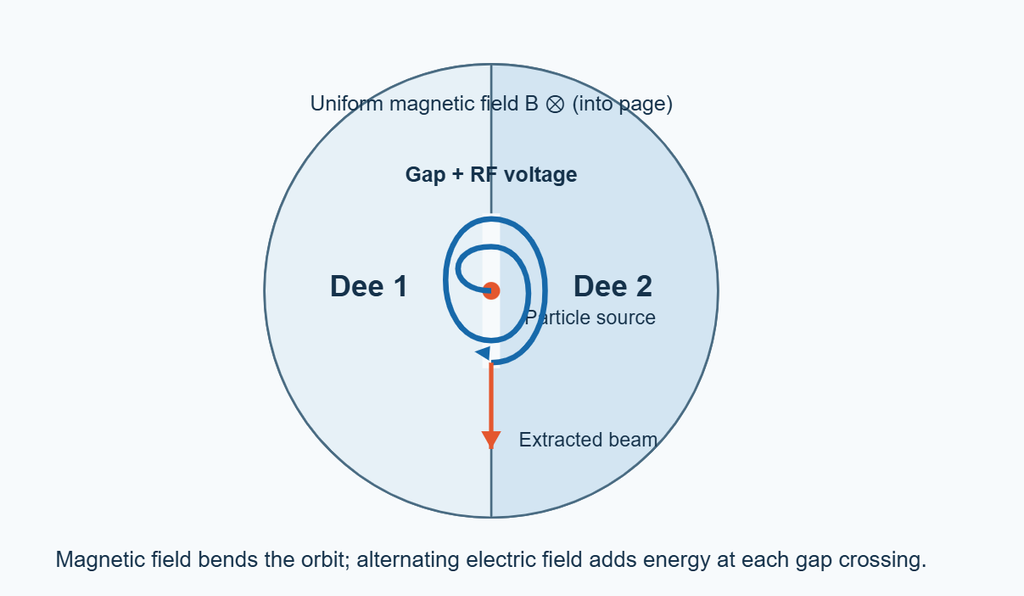
- The magnetic field bends particles into circular orbits; the electric field accelerates them as they cross the gap between two hollow electrodes called Dees.
- In the classical, nonrelativistic model, the cyclotron frequency is \(f=|q|B/(2\pi m)\).
- Each gap crossing increases a particle’s kinetic energy. As its speed rises, its orbit radius grows, forming an outward spiral.
- Cyclotrons are used in research, medical radioisotope production, and some particle therapy systems.
What Is a Cyclotron?
A cyclotron is a particle accelerator that repeatedly guides charged particles around a circular path while increasing their energy. It combines a magnetic field, which curves the path, with an alternating electric field, which accelerates the particles.
A cyclotron accelerates charged particles such as protons, deuterons, or ions. It does not accelerate photons: photons have no electric charge and are not accelerated by the electric field in the gap.
Force on a Charged Particle in a Magnetic Field
A particle with charge \(q\) moving at velocity \(\mathbf{v}\) through a magnetic field \(\mathbf{B}\) experiences the magnetic part of the Lorentz force:\[ \mathbf{F}=q(\mathbf{v}\times\mathbf{B}) \]
Its magnitude is:\[ F=|q|vB\sin\theta \]
where \(\theta\) is the angle between the particle’s velocity and the magnetic field. If the particle moves parallel to the field, the magnetic force is zero. If it moves perpendicular to the field, the force is greatest and acts at right angles to the motion.
Because this magnetic force is perpendicular to the particle’s velocity, it changes the direction of motion but does no work on the particle. The particle’s speed stays constant while it travels inside a Dee.
Circular Motion in the Magnetic Field
When a charged particle enters a uniform magnetic field at right angles, the magnetic force provides the centripetal force that bends its path into a circle:\[ |q|vB=\frac{mv^2}{r} \]
So the orbit radius is:\[ r=\frac{mv}{|q|B} \]
Here, \(m\) is the particle’s mass and \(r\) is the radius of its path. As the particle gains speed, its orbit radius increases.
For a nonrelativistic particle, the time for one complete revolution and the corresponding frequency are:\[ T=\frac{2\pi m}{|q|B} \qquad f=\frac{1}{T}=\frac{|q|B}{2\pi m} \]
In this classical model, the revolution frequency does not depend on the particle’s speed or orbit radius. That lets the alternating voltage be timed to accelerate the particle each time it crosses the gap. Berkeley Lab’s accelerator physics material derives these relationships.
Basic Construction
A classical cyclotron has these main parts:
- Electromagnet: Produces a magnetic field perpendicular to the particle’s orbit.
- Two Dees: Hollow, D-shaped metal electrodes facing each other across a narrow gap. Their shape shields particles inside them from the accelerating electric field.
- Radio-frequency (RF) voltage source: Applies an alternating voltage between the Dees.
- Particle source: Injects charged particles near the centre.
- Extraction system: Directs the accelerated particles out toward a target or beamline.
How a Cyclotron Works
- The particle source releases charged particles near the centre of the Dees.
- The magnetic field bends each particle into a semicircular path inside a Dee.
- As the particle reaches the gap, the RF voltage has switched polarity so the electric field accelerates it across the gap.
- The particle enters the other Dee at a higher speed and travels along a larger semicircle.
- Each time it crosses the gap, it gains more kinetic energy and follows a wider orbit.
- Near the outer edge, an extraction system guides the particle out of the cyclotron.
For an accelerating potential difference \(V\), the ideal energy gain at one gap crossing is approximately:\[ \Delta K=|q|V \]
The particle gains energy at the gap; the magnetic field guides its orbit between crossings. CERN’s accelerator teaching material also describes the alternating gap field and the need to synchronize it with the particle’s motion.
Applications of Cyclotrons
Cyclotrons are used in scientific research and medicine. Medical cyclotrons can produce radioisotopes used in diagnostic imaging, including PET and SPECT applications. Cyclotron beams are also used in some proton therapy systems. The International Atomic Energy Agency’s cyclotron resource covers cyclotrons used for radionuclide production.
Limitations of the Classical Cyclotron
The standard frequency formula assumes particles move at speeds well below the speed of light. At higher energies, relativistic effects change the particle’s effective inertia and reduce its revolution frequency. The particle can then fall out of step with a fixed-frequency RF voltage. Specialized designs, including synchrocyclotrons and isochronous cyclotrons, address this synchronization problem. Berkeley Lab summarizes the nonrelativistic limitation.
Summary
A cyclotron uses a magnetic field to bend charged particles into circular paths and an alternating electric field to accelerate them at each crossing between its Dees. The particles gain energy step by step, their orbit radius grows, and an extraction system sends the resulting beam to an experiment or application.