
Key Takeaways
- Electrical energy is energy transferred when electric charge moves through a potential difference.
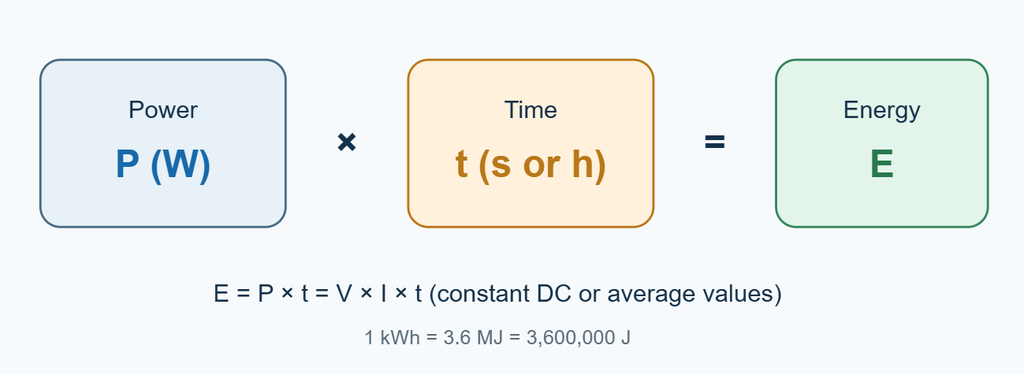
- For constant voltage and current, energy is \(E=VIt\), or equivalently \(E=Pt\).
- The SI unit of energy is the joule (J).
- Electricity bills commonly measure energy in kilowatt-hours (kWh).
- One kilowatt-hour equals 3.6 million joules.
What Is Electrical Energy?
Electrical energy is the energy transferred by an electric circuit or device. When charge moves through a potential difference, energy is transferred to or from the electrical component.
For a charge \(q\) moving through a potential difference \(V\), the energy transfer is:\[ E=qV \]
Here, \(E\) is energy in joules, \(q\) is charge in coulombs, and \(V\) is potential difference in volts. Since current is the rate at which charge flows, \(I=q/t\), we can express the energy transfer in terms of current and time.
Electrical Energy Formula
For constant voltage and current:\[ E=VIt \]
Since electrical power is \(P=VI\), the same relationship can be written:\[ E=Pt \]
Where:
- \(E\) = energy transferred, in joules (J)
- \(P\) = power, in watts (W)
- \(V\) = potential difference, in volts (V)
- \(I\) = current, in amperes (A)
- \(t\) = time, in seconds (s)
For changing voltage or current, use instantaneous power \(p(t)=v(t)i(t)\), then calculate total energy over a time interval:\[ E=\int_{t_1}^{t_2}v(t)i(t)\,dt \]
For AC circuits, average real power over time is used to calculate energy consumption. OpenStax explains how electrical power and energy relate in circuits.
Example Calculation
A \(60\ \text{W}\) lamp operates for \(5\) hours. Its energy use is:\[ E=Pt=(60\ \text{W})(5\ \text{h})=300\ \text{Wh}=0.3\ \text{kWh} \]
In joules, \(5\) hours is \(18{,}000\) seconds, so:\[ E=(60\ \text{J/s})(18{,}000\ \text{s})=1{,}080{,}000\ \text{J} \]
Units of Electrical Energy
The SI unit of energy is the joule. A joule is one watt-second:\[ 1\ \text{J}=1\ \text{W}\cdot\text{s} \]
For practical energy measurements, especially electricity billing, larger units are more convenient:
- Watt-hour (Wh): Energy used by a 1-watt device operating for 1 hour.
- Kilowatt-hour (kWh): Energy used by a 1-kilowatt device operating for 1 hour.
- Megawatt-hour (MWh): 1,000 kWh.
The conversion is:\[ 1\ \text{kWh}=1{,}000\ \text{W}\times3{,}600\ \text{s} =3{,}600{,}000\ \text{J}=3.6\ \text{MJ} \]
NIST lists the kilowatt-hour conversion as \(3.6\ \text{MJ}\). See NIST’s unit conversion reference.
What Is a “Unit” of Electricity?
On many electricity bills, one “unit” of electrical energy means one kilowatt-hour. For example, a \(2\ \text{kW}\) heater running for \(3\) hours uses:\[ E=(2\ \text{kW})(3\ \text{h})=6\ \text{kWh} \]
The bill’s energy charge is generally based on the number of kilowatt-hours used and the applicable rate. OpenStax discusses using kilowatt-hours to estimate appliance energy use and cost.
Summary
Electrical energy describes how much energy is transferred or consumed over time. For constant voltage and current, use \(E=VIt\); if power is known, use \(E=Pt\). Joules are the standard SI unit, while kilowatt-hours provide a convenient unit for household and commercial electricity use.