
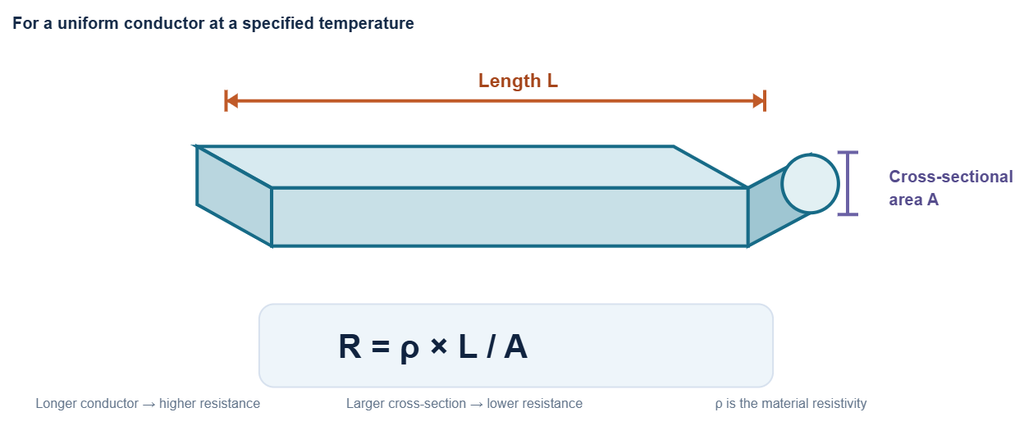
Resistance describes how strongly a particular component opposes current. Resistivity describes a material’s contribution to that resistance. For a uniform conductor, resistance depends on its material, length, cross-sectional area, and temperature.
What is resistivity?
Resistivity, written as ρ (rho), is a property of a material that describes how strongly it opposes electric current. A low-resistivity material, such as copper, conducts well. A high-resistivity material offers more opposition.
Resistivity is different from resistance. Resistance depends on the size and shape of a particular object; resistivity describes the material itself at a stated temperature and condition.
The relationship between resistance and conductor dimensions
For a uniform conductor with a consistent cross-section and material:
R = ρ × L / A
Where:
- R is resistance in ohms (Ω)
- ρ is resistivity in ohm-metres (Ω·m)
- L is conductor length in metres (m)
- A is cross-sectional area in square metres (m²)
This equation summarizes the main geometry relationships.
First relationship: resistance increases with length
For the same material and cross-sectional area, resistance is directly proportional to length:
R ∝ L
A longer conductor gives current a longer path through the material, so its resistance is greater.
Second relationship: resistance decreases with cross-sectional area
For the same material and length, resistance is inversely proportional to cross-sectional area:
R ∝ 1/A
A thicker conductor has more area available for current to flow through, so its resistance is lower.
Material and temperature also matter
For conductors with the same dimensions, the material with greater resistivity has greater resistance. Resistivity also changes with temperature. Many metals have higher resistivity as they heat, but temperature behavior varies by material. (OpenStax: Resistivity and resistance)
Worked example
A copper wire is 10 m long and has a cross-sectional area of 1 mm². Using copper’s approximate resistivity at 20°C, 1.68 × 10⁻⁸ Ω·m:
First convert the area:
1 mm² = 1 × 10⁻⁶ m²
Then calculate:
R = (1.68 × 10⁻⁸ × 10) / (1 × 10⁻⁶)
R ≈ 0.168 Ω
This estimates the resistance of that 10 m conductor at about 20°C. If the circuit’s current travels out and back through two similar 10 m wires, the total wire resistance is approximately 0.336 Ω, before accounting for connections and temperature. (OpenStax: Resistivity example and SI units)
Unit of resistivity
In the SI system, resistivity is measured in ohm-metres (Ω·m). This follows from rearranging the resistance equation:
ρ = R × A / L
A commonly used alternative is ohm-centimetres (Ω·cm). The conversion is:
1 Ω·m = 100 Ω·cm
Be careful to convert length and area consistently when using the formula. For example, if resistivity is in Ω·m, use metres and square metres.
Approximate resistivity of common materials
These are typical values near 20°C. Actual values vary with purity, alloy composition, processing, and temperature. (HyperPhysics: Resistivity values at 20°C)
| Material | Approximate resistivity (Ω·m) |
|---|---|
| Silver | 1.59 × 10⁻⁸ |
| Copper | 1.68 × 10⁻⁸ |
| Aluminum | 2.65 × 10⁻⁸ |
| Gold | 2.44 × 10⁻⁸ |
| Iron | 9.71 × 10⁻⁸ |
| Constantan alloy | 4.9 × 10⁻⁷ |
Carbon and many semiconductors are not included because their resistivity can vary widely with composition, impurities, and other conditions.
How temperature affects resistivity
For many pure metals over a limited range near room temperature, resistivity can be approximated by:
ρ₂ = ρ₁ × [1 + α₁(T₂ − T₁)]
Here, α₁ is the temperature coefficient referenced to temperature T₁. This is a useful approximation for modest temperature changes; it does not describe every material or a wide temperature range.
Key points
For a uniform conductor, R = ρL/A: longer conductors have more resistance, while larger cross-sections have less. The material’s resistivity and temperature also affect the result. Resistivity is measured in Ω·m in SI units, and published values should always be read with their reference temperature and material details in mind.