
The International System of Units, abbreviated SI, is the internationally agreed system used to express measurements in science, engineering, industry, and trade. It provides a consistent way to describe quantities such as length, mass, time, temperature, and electric current.
What does SI mean?
SI comes from the French name Système international d’unités. The system was established in 1960. The mole was added as the seventh base unit in 1971. Since 20 May 2019, the SI has been defined using fixed numerical values of seven fundamental constants of nature. (BIPM: The International System of Units, BIPM: SI history)
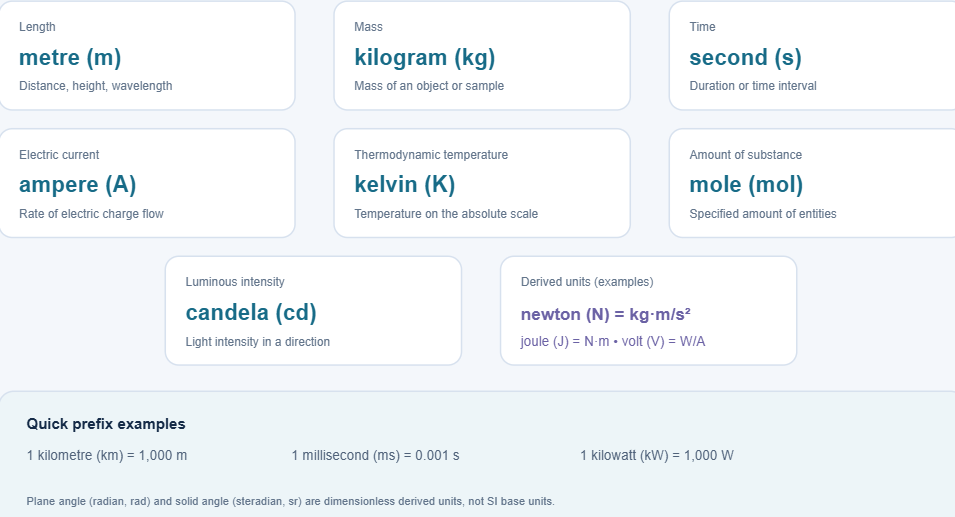
The seven SI base units
| Quantity | SI base unit | Symbol |
|---|---|---|
| Length | metre | m |
| Mass | kilogram | kg |
| Time | second | s |
| Electric current | ampere | A |
| Thermodynamic temperature | kelvin | K |
| Amount of substance | mole | mol |
| Luminous intensity | candela | cd |
The SI also includes derived units, formed by combining base units. For example:
- Speed: metre per second (m/s)
- Force: newton (N), where 1 N = 1 kg·m/s²
- Energy: joule (J), where 1 J = 1 N·m
- Power: watt (W), where 1 W = 1 J/s
The radian (rad) and steradian (sr) are used for plane and solid angles. They are dimensionless derived units, not additional base units. (NIST: SI base and derived units)
SI prefixes
SI prefixes express decimal multiples and fractions of units:
- kilo (k) means 1,000, so 1 km = 1,000 m.
- milli (m) means one-thousandth, so 1 ms = 0.001 s.
- mega (M) means 1,000,000, so 1 MW = 1,000,000 W.
Prefixes make very large and small measurements easier to write. Pay attention to capitalization: m means milli, while M means mega.
Advantages of the SI system
- Consistent relationships: Derived units connect naturally to the base units. For example, force is measured in kg·m/s².
- Decimal scaling: Prefixes make it straightforward to scale measurements by powers of ten.
- Shared standards: A common system makes it easier to compare results and exchange technical information internationally.
- Reproducible definitions: Modern SI units are based on fixed constants, rather than depending on a single physical object. (BIPM: The SI)
Limitations and practical considerations
SI is widely used, but people and industries may still use other units in everyday settings. For example, a home’s floor area may be quoted in square feet in one market and square metres in another. Converting between them takes an extra step and can introduce errors if the conversion is done incorrectly.
SI prefixes also require care. Confusing millimetres with metres or milligrams with kilograms can lead to large mistakes. Clear unit labels and dimensional checks help prevent them.
These are practical challenges of using different measurement conventions. They do not mean SI is inherently inaccurate; the accuracy of a measurement depends on the instrument, method, and uncertainty.
Key points
SI is the internationally agreed measurement system built around seven base units. Other units, such as newtons and joules, are derived from them. Its consistent relationships and decimal prefixes simplify technical work, while conversions and prefix mistakes are important practical considerations.