
Electricity is a broad term for phenomena involving electric charge. In a circuit, electric current is the rate at which charge flows. That charge movement can transfer energy to a load such as a lamp, motor, or computer.
Electricity is not simply “the flow of electrons.” Electrons carry current in metal wires, but other materials carry charge in different ways—for example, ions in an electrolyte and electrons and holes in a semiconductor. (OpenStax: Electric Current)
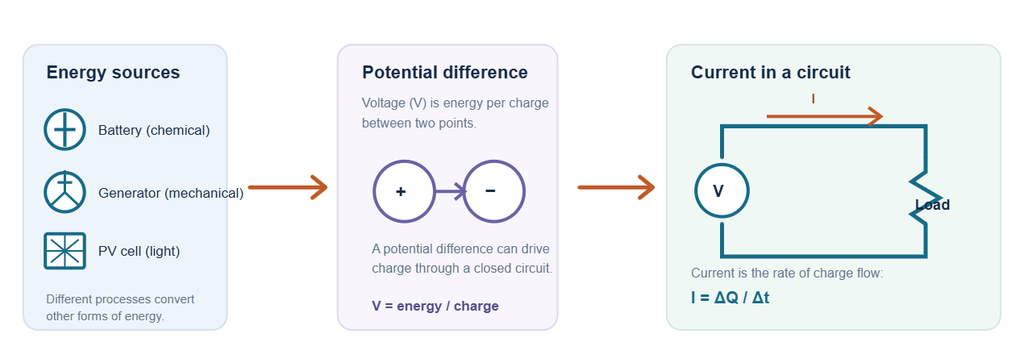
Charge, current, voltage, and electric fields
These related terms describe different parts of electrical behavior:
- Electric charge (Q) is a property of particles. Electrons have negative charge; protons have positive charge. Charge is measured in coulombs (C).
- Electric current (I) is the rate at which charge passes a point: I = ΔQ / Δt. Its unit is the ampere (A), equal to one coulomb per second.
- Voltage is electric potential difference: the change in electrical potential energy per unit charge between two points. It is measured in volts (V).
- An electric field is a region where an electric charge experiences a force. In a circuit, the electric field helps drive charge through the conductors and components.
In ordinary metal circuits, electrons drift from the negative side toward the positive side. Circuit diagrams usually show conventional current in the opposite direction, as if positive charge were moving. (OpenStax: Ohm’s Law and Current Direction)
How electricity is generated
Electricity is produced by converting other forms of energy into electrical energy. Common methods include:
- Electromagnetic generation: A turbine or other mechanical source turns a generator. This is used in many hydroelectric, wind, and thermal power plants.
- Electrochemical generation: Chemical reactions in a battery create a voltage that can drive current.
- Photovoltaic generation: Solar cells convert light directly into electrical energy. Their output is DC; in grid-connected systems, an inverter can convert it to AC.
These methods are examples of a wider range of technologies used to generate electricity. (U.S. Energy Information Administration: How Electricity Is Generated)
AC and DC
Direct current (DC) flows in one direction through a circuit. Batteries and solar cells provide DC.
Alternating current (AC) periodically reverses direction. Power grids commonly use AC, though the exact supply system depends on the region and application. Generators often produce AC directly. A DC generator uses a commutator to provide a DC output.
AC and DC are each useful in different systems. Devices can also convert one form to the other—for example, a power adapter converts AC mains power to DC for electronics.
How electricity reaches homes and businesses
Power plants and other sources feed electricity into a grid. For many long-distance lines, transformers raise the AC voltage so the same power can be transmitted with less current and lower resistive losses. Substations then adjust the voltage for regional networks and local distribution.
Some transmission systems use high-voltage direct current (HVDC), particularly where the system design makes DC advantageous. The choice between AC and DC depends on factors such as distance, capacity, network connections, and conversion equipment. (U.S. Environmental Protection Agency: Electric Power Sector Basics)
Key points
Electricity involves electric charge, electric fields, and energy transfer. Current measures how quickly charge flows; voltage measures the change in energy per charge between two points. Generators, batteries, and solar cells produce electricity through different physical processes, while power grids use transformers and transmission lines to deliver it to users.