
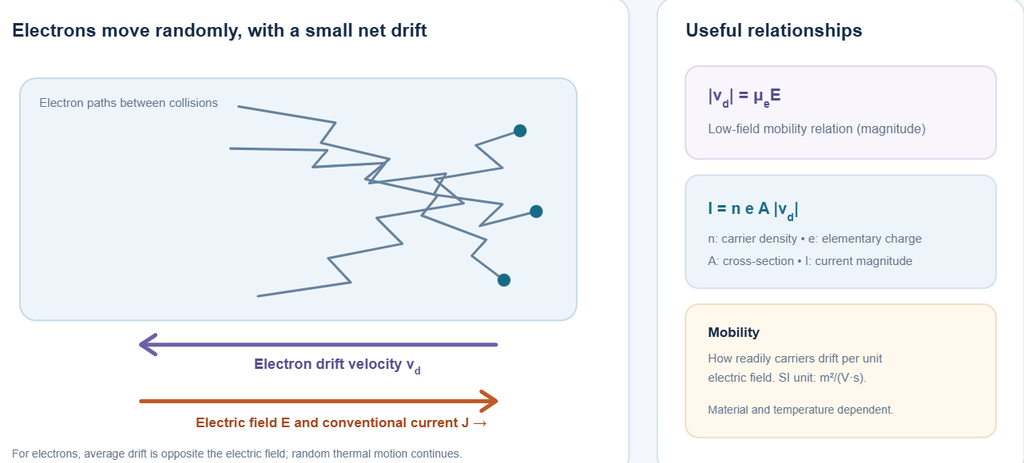
Electrons in a metal move in many directions because of thermal motion. When an electric field is applied, their motion gains a small average direction. This average motion is called drift velocity.
Drift velocity helps explain how current flows in a conductor, why electron motion differs from conventional current, and how a material’s mobility affects charge transport.
What is drift velocity?
Drift velocity is the average velocity of charge carriers caused by an electric field. In a metal wire, the carriers are electrons. They continue to move and scatter randomly, but the field gives them a small net drift toward the positive terminal.
Because electrons are negatively charged, their drift direction is opposite the electric field. Conventional current is defined in the direction positive charge would move, so it points with the field. (OpenStax: Model of Conduction in Metals)
Drift velocity is usually much slower than the random motion of individual electrons. That does not mean an electrical circuit responds only as fast as an electron travels from one end of a wire to the other: the electric field that influences charges is established through the circuit much faster than the carriers’ net drift.
Drift current
When charge carriers drift through a conductor, they produce a current. For electrons in a uniform wire, the current magnitude can be estimated with:
I = n e A |vₙ|
Where:
- I is current in amperes (A)
- n is the number of free electrons per cubic metre (m⁻³)
- e is the elementary charge, approximately 1.602 × 10⁻¹⁹ C
- A is the conductor’s cross-sectional area in square metres (m²)
- |vₙ| is the magnitude of electron drift velocity in metres per second (m/s)
Rearranging gives:
|vₙ| = I / (n e A)
This relation is useful for estimating electron drift in a metal wire. In semiconductors, both electrons and holes can carry current, so the total current may include contributions from both.
Not all electrical current is drift current. For example, diffusion of carriers also contributes to current in semiconductor devices.
Example: Drift speed in a copper wire
Consider a copper wire with a cross-sectional area of 1 mm² carrying 1 A. Use an approximate free-electron density for copper of 8.5 × 10²⁸ m⁻³:
1 mm² = 1 × 10⁻⁶ m²
|vₙ| = 1 / [(8.5 × 10²⁸)(1.602 × 10⁻¹⁹)(1 × 10⁻⁶)]
|vₙ| ≈ 7.3 × 10⁻⁵ m/s, or about 0.073 mm/s
This is an approximate value. The actual carrier density depends on the conductor, and the calculation assumes a uniform current density. (OpenStax: Electric Current)
What is electron mobility?
Electron mobility, written as μₑ, describes how readily electrons drift in response to an electric field. In a material operating in its low-field range, drift speed is proportional to field strength:
|vₙ| = μₑ E
Where:
- |vₙ| is electron drift-speed magnitude
- μₑ is electron mobility
- E is electric-field strength in volts per metre (V/m)
Mobility is often expressed in m²/(V·s). A higher mobility means carriers drift faster for the same electric-field strength. Mobility depends on the material and conditions such as temperature; at high fields, the simple proportional relationship may no longer hold. (UCLA: Basic Semiconductor Devices)
Key points
Drift velocity is the average motion of charge carriers caused by an electric field. In metal wires, electrons drift opposite the field while conventional current points with it. Drift current depends on carrier density, charge, conductor area, and drift speed. Mobility describes how readily carriers respond to the field.