
The 7805 is a fixed linear voltage regulator designed to provide a nominal +5 V DC output. It is part of the 78xx family, where “05” indicates the output voltage. It is often used to power simple electronic circuits from a higher DC voltage.
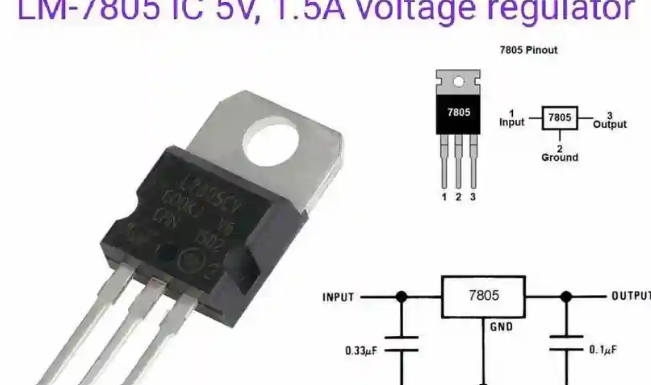
The 7805 is not a complete power supply by itself. It needs a suitable input source, correct wiring, and enough cooling for the power it dissipates as heat. Specifications also vary between manufacturers and packages, so check the datasheet for the exact part you have.
7805 pins
Many common TO-220 versions have three pins:
- Input: Connect the unregulated DC supply.
- Ground: Connect the circuit’s 0 V reference.
- Output: Provides the regulated 5 V output.
Confirm the pin arrangement and metal-tab connection in the specific manufacturer’s datasheet. Pinouts can differ between packages or related devices.
Input voltage and dropout
A 7805 needs its input voltage to remain sufficiently above 5 V to regulate properly. A common rule of thumb is to provide about 7–8 V or more, but the exact minimum depends on the specific part and load. For example, TI specifies a 7.5 V input for line regulation under some LM7805 conditions. (TI: LM7805 family datasheet)
The maximum input voltage is also part-specific. Do not assume every 7805 can safely accept 35 V; check the operating and absolute-maximum ratings for your exact device. A higher input voltage creates more heat even when the regulator remains within its voltage rating.
How much heat does a 7805 produce?
As a linear regulator, the 7805 dissipates approximately the voltage it drops multiplied by the output current:
P ≈ (Vin − Vout) × Iout
For a 5 V output at 0.5 A:
- With a 16 V input: (16 − 5) × 0.5 = 5.5 W
- With a 9 V input: (9 − 5) × 0.5 = 2 W
Those are substantial amounts of heat for a small component. The regulator may need a heatsink, or the design may need a lower input voltage or a switching regulator. The allowable output current depends on the specific device, package, heatsink, and surrounding temperature; a headline current rating does not guarantee the regulator can supply that current in every setup. TI’s datasheet describes thermal limits and package-dependent power dissipation. (TI: 7805 thermal and electrical specifications)
For an approximate efficiency estimate, a linear regulator’s efficiency is often close to Vout / Vin, ignoring its own operating current. With a 16 V input and 5 V output, that is about 31%. Much of the remaining input power becomes heat.
What is inside the regulator?
A 7805 uses an internal voltage reference and feedback control circuit to compare the output with its target. The control circuit adjusts an internal series pass transistor to correct changes in input voltage or load current.
Many 78xx devices also include protection features such as current limiting and thermal shutdown. These help protect the regulator under some fault conditions, but they do not replace proper current, voltage, or thermal design. (TI: LM7805 product information)
Basic 7805 circuit
A basic circuit connects:
- The unregulated DC supply to the input pin.
- Circuit ground to the ground pin.
- The regulated 5 V load to the output pin.
Input and output capacitors may be needed to improve stability, transient response, or noise performance. Their values and placement depend on the particular regulator and circuit. Follow the datasheet recommendations; for example, TI’s 7805 family documentation shows a typical fixed-regulator circuit and explains its capacitor requirements. (TI: 7805 typical application circuit)
A 7805 requires a DC input within its specified range. If starting with AC, a suitable transformer, rectifier, and smoothing capacitor are needed before the regulator. Those parts must be rated for the voltage and current, and the smoothed DC voltage must stay within the regulator’s limits under both light and heavy load.
Common applications
The 7805 can provide a 5 V rail for:
- Microcontroller and logic circuits
- Small sensor or control boards
- Simple bench and educational projects
- Low-current circuits that need a fixed 5 V supply
It is generally a poor choice when the input voltage is much higher than 5 V or the load current is large, because the resulting heat can be difficult to manage. Many modern USB chargers use switching power supplies; a bare 7805 is not designed to connect directly to mains electricity.
When to choose a different regulator
Consider a switching regulator if you need to convert a much higher voltage to 5 V, supply significant current, or reduce heat and energy loss. A low-dropout linear regulator may help when the input is only slightly above 5 V, though its own voltage, current, and thermal limits still apply.
Key points
The 7805 provides a nominal 5 V output when used within the exact device’s limits. Check its pinout, required input voltage, maximum ratings, output current, and capacitor recommendations in the manufacturer’s datasheet. Calculate heat using (Vin − 5 V) × output current before deciding whether the package needs a heatsink or a different regulator.