
Electrical polarity identifies which of two points is at a higher electric potential. In a DC circuit, source terminals are marked positive (+) and negative (−). Those markings help show how components should be connected and how voltage changes around the circuit.
Polarity matters when connecting batteries, diodes, polarized capacitors, meters, and other components. It also matters when combining voltage sources.
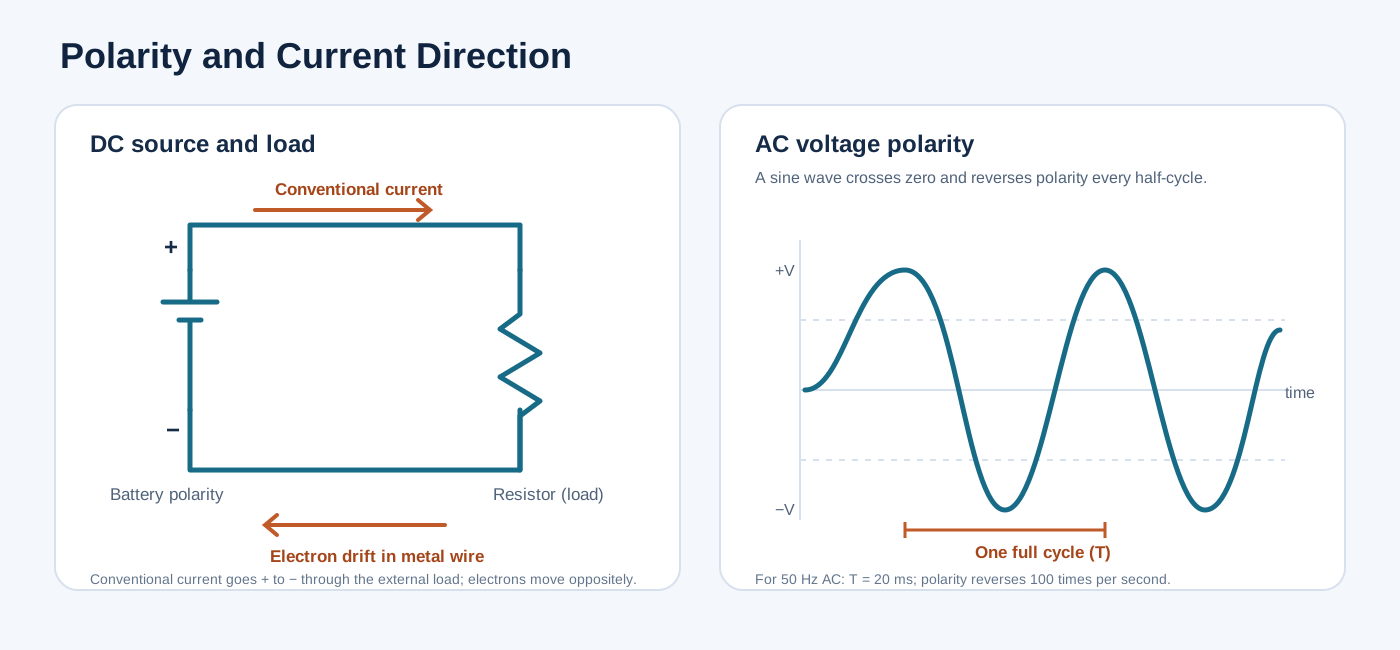
Polarity in a DC circuit
A battery creates a voltage difference between its terminals. In circuit diagrams, conventional current is treated as flowing from the positive terminal, through the external circuit, toward the negative terminal.
In metal wires, the mobile charge carriers are electrons, which drift in the opposite direction. Both descriptions are valid: conventional current is the standard direction used in circuit analysis, while electron flow describes the movement of electrons in a metal conductor. (OpenStax: Ohm’s Law and conventional current)
Polarity alone does not determine the current in every possible circuit. The voltage sources, component connections, and circuit conditions together determine the current. For a resistor, the passive sign convention marks the terminal where conventional current enters as positive for the voltage drop across that resistor.
What polarity means for components
Some components work as intended only when connected with the correct polarity:
- Diodes and LEDs mainly conduct in one direction.
- Polarized capacitors have positive and negative terminals.
- Batteries must be connected with the intended terminal orientation.
- Meters may show a negative reading if their leads are reversed relative to the chosen reference direction.
Always check the component markings and datasheet. Reversing polarity can cause incorrect operation or damage, depending on the component.
Adding DC voltage sources in series
When DC sources are connected in series, their voltages add or subtract according to their orientation.
- Series-aiding: The sources are oriented so their voltages reinforce each other. A 6 V source and a 4 V source provide a total of 10 V.
- Series-opposing: One source is reversed relative to the other. The net voltage is the difference: 6 V opposing 4 V gives 2 V, with polarity set by the stronger source.
In a real circuit, the available voltage and current also depend on the sources’ ratings and internal resistance. Do not connect sources in series unless their manufacturer’s instructions allow it.
Polarity in AC circuits
An AC voltage changes with time and reverses polarity periodically. When the waveform is positive relative to its reference, one terminal is positive; during the negative half-cycle, the polarity is reversed.
For a 50 Hz AC supply, one complete cycle takes 20 milliseconds. The polarity reverses twice per cycle, giving 100 reversals per second. At 60 Hz, the period is about 16.7 milliseconds, with 120 reversals per second. (OpenStax: AC sources)
AC voltage can have a negative instantaneous value; “negative” simply means its polarity is opposite to the selected reference at that moment. When combining sinusoidal AC sources at the same frequency, account for their phase as well as their magnitude and polarity. Sources at different frequencies cannot be combined into a single same-frequency phasor; their instantaneous waveforms add over time.
Key points
Polarity shows the relative positive and negative terminals or voltage direction in a circuit. Conventional current is defined from positive to negative through the external circuit; electrons in metal wires move in the opposite direction. For DC sources in series, orientation determines whether voltages add or oppose. AC polarity reverses over time, so frequency and phase matter when analyzing AC circuits.