
A material’s electrical resistance can change as its temperature changes. The temperature coefficient of resistance (TCR) describes the relative change in resistance per degree of temperature change.
TCR helps engineers predict how resistors, wires, sensors, and other components will behave as they heat up or cool down. Its value depends on the material and the reference temperature, and it may change across a wide temperature range.
TCR formula
Over a limited temperature range, resistance is often approximated as changing linearly:
R₂ = R₁ × [1 + α₁(T₂ − T₁)]
Where:
- R₁ is resistance at the reference temperature T₁
- R₂ is resistance at the new temperature T₂
- α₁ is the TCR referenced to T₁, usually expressed in °C⁻¹ or K⁻¹
The temperature difference has the same numerical value in degrees Celsius and kelvins. TCR may also be given in parts per million per degree Celsius (ppm/°C). For example, 100 ppm/°C equals 0.0001/°C.
This formula is an approximation. For materials with strongly nonlinear resistance-temperature behavior, such as thermistors, use the manufacturer’s resistance curve or model instead. (Vishay: Temperature coefficient of resistance)
Example: Estimating copper wire resistance
Suppose a copper wire has a resistance of 100 Ω at 20°C. Use an approximate copper TCR of 0.00386/°C at 20°C to estimate its resistance at 70°C:
R₂ = 100 × [1 + 0.00386 × (70 − 20)]
R₂ ≈ 119.3 Ω
So, under this linear approximation, the resistance rises by about 19.3 Ω. The actual value can differ because the material’s TCR changes with temperature and the wire’s construction also matters. (HyperPhysics: Resistivity and temperature coefficients)
Positive, negative, and low TCR
Positive temperature coefficient
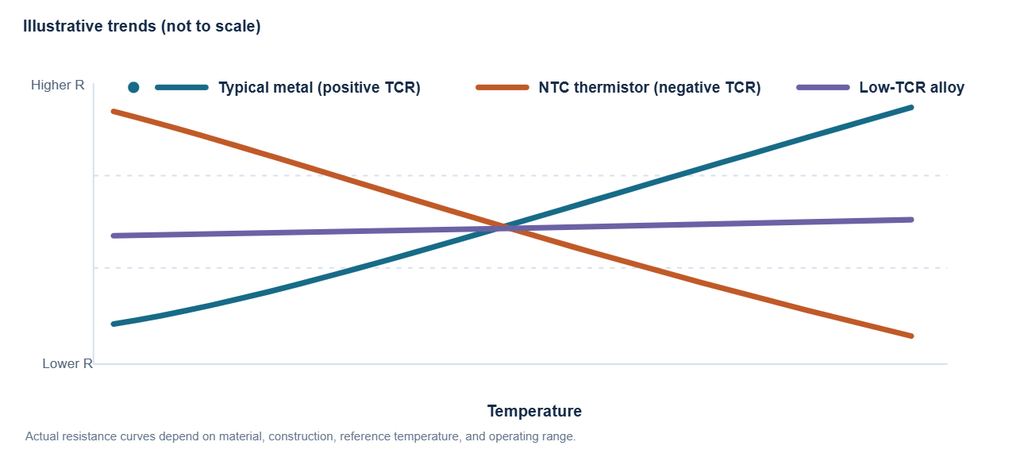
A positive TCR means resistance increases as temperature rises. Many pure metals, including copper and aluminum, show this behavior over ordinary operating ranges. As metal atoms vibrate more at higher temperatures, electrons encounter more scattering, which raises resistance.
Negative temperature coefficient
A negative TCR means resistance decreases as temperature rises. NTC thermistors are semiconductor-based sensors designed to have this response. Their resistance changes substantially with temperature, making them useful for temperature measurement and compensation. (TDK: NTC thermistors)
It is too broad to say that all nonmetals and semiconductors have a negative TCR. Their behavior depends on the material, its composition, and temperature. Some devices, such as PTC thermistors, are designed so resistance rises sharply over part of their temperature range.
Low or near-zero TCR
Some alloys, including manganin and constantan, have a low TCR over specified ranges. Their resistance changes less with temperature than many pure metals, which can make them useful in precision resistors and measurement equipment. “Low TCR” does not mean the resistance is perfectly constant at every temperature.
TCR values depend on reference temperature
A coefficient stated at 20°C describes the local or approximate resistance change around that reference point. A value based at 0°C may be different. Always check the reference temperature, material grade, and temperature range when using a published coefficient.
For a resistor, the manufacturer may specify TCR in ppm/°C. For a thermistor, resistance is commonly provided in a table or curve because a single linear coefficient may not describe its behavior across the operating range.
Where TCR is useful
TCR is important when designing or using:
- Precision resistors and current-sensing circuits
- Copper wiring that carries significant current
- Resistance temperature detectors (RTDs)
- NTC and PTC thermistor circuits
- Measurement equipment that must remain accurate as it warms up
Key points
TCR describes how resistance changes with temperature relative to a reference point. A positive coefficient means resistance tends to rise; a negative coefficient means it tends to fall. Use R₂ = R₁[1 + α₁(T₂ − T₁)] for a useful linear estimate over a limited range, and use manufacturer data for nonlinear devices or wide temperature ranges.