
Electric power is the rate at which electrical energy is transferred, converted, absorbed, or delivered. It tells us how quickly a circuit element uses or supplies energy.
A higher-wattage lamp, for example, uses energy faster than a lower-wattage lamp when each operates at its rated conditions. Electricity bills, however, usually charge for energy used over time, measured in kilowatt-hours (kWh), rather than power alone.
Electric power formula
Power is the rate of energy transfer:
P = dW / dt
Where P is power in watts, W is energy in joules, and t is time in seconds. One watt equals one joule per second.
For a circuit element, instantaneous power is:
p(t) = v(t) × i(t)
where voltage and current are measured across and through the element at that instant.
For a resistor, Ohm’s law gives these equivalent formulas:
P = V × I
P = I² × R
P = V² / R
For example, a 24 V resistor carrying 2 A absorbs:
P = 24 × 2 = 48 W
These formulas assume the values are consistent with the circuit conditions. For AC circuits, use RMS voltage and current when calculating average power for a purely resistive load.
Passive sign convention
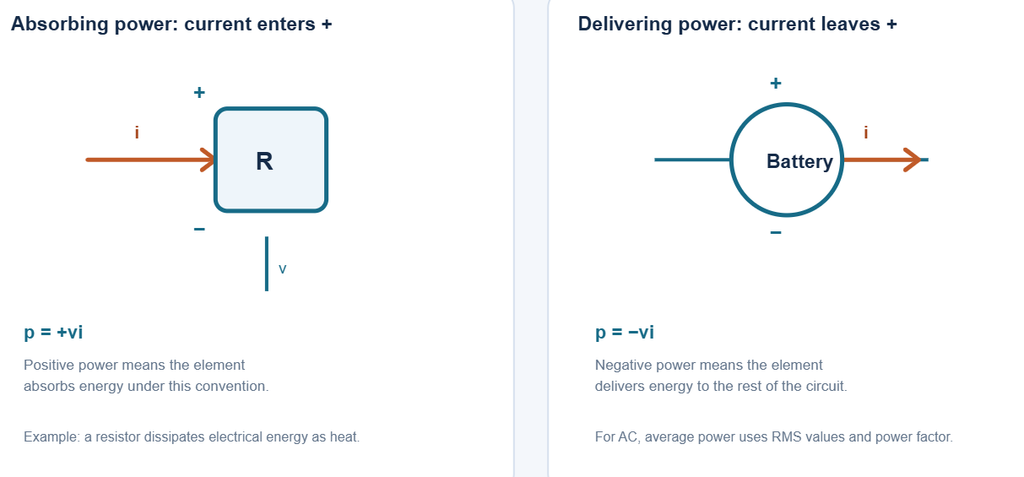
The passive sign convention sets the reference directions for voltage and current:
- If the reference current enters the terminal marked positive, calculate power as p = vi.
- If p is positive, the element is absorbing power under that convention.
- If p is negative, the element is delivering power to the circuit.
A resistor normally absorbs power and converts electrical energy into heat. A battery supplying a load normally delivers power, with current leaving its positive terminal. A rechargeable battery can absorb power while charging, so whether a battery supplies or consumes power depends on how current is flowing.
Power in AC circuits
In AC circuits, voltage and current may be out of phase. For sinusoidal AC, the average real power is:
Pavg = Vrms × Irms × cos φ
Here φ is the phase angle between voltage and current, and cos φ is the power factor. For a pure resistor, voltage and current are in phase, so the power factor is 1. (OpenStax: Power in an AC Circuit)
Power and energy are different
Power describes how quickly energy is transferred. Energy describes the total amount transferred over a period:
E = P × t
For a 60 W lamp operated for 5 hours:
E = 60 W × 5 h = 300 Wh = 0.3 kWh
The kilowatt-hour is a unit of energy, not power. Utilities commonly use kWh to measure electricity consumption. (U.S. Energy Information Administration: Measuring Electricity)
Key points
Electric power is the rate of energy transfer and is measured in watts. Use p = vi for instantaneous power, following the chosen voltage and current references. Under the passive sign convention, positive power means absorption and negative power means delivery. Electricity bills generally measure energy consumption in kilowatt-hours.