
Key Takeaways
- Ionization energy is the minimum energy needed to remove an electron from an isolated gaseous atom or ion.
- Removing an electron from a neutral atom creates a positive ion, or cation.
- Successive ionization energies of the same atom increase; a particularly large jump often occurs after all valence electrons have been removed.
- Ionization energy generally increases across a period and decreases down a group, with some exceptions.
- Low ionization energy can help explain how readily an atom loses electrons, but it does not by itself determine a solid metal’s electrical conductivity.
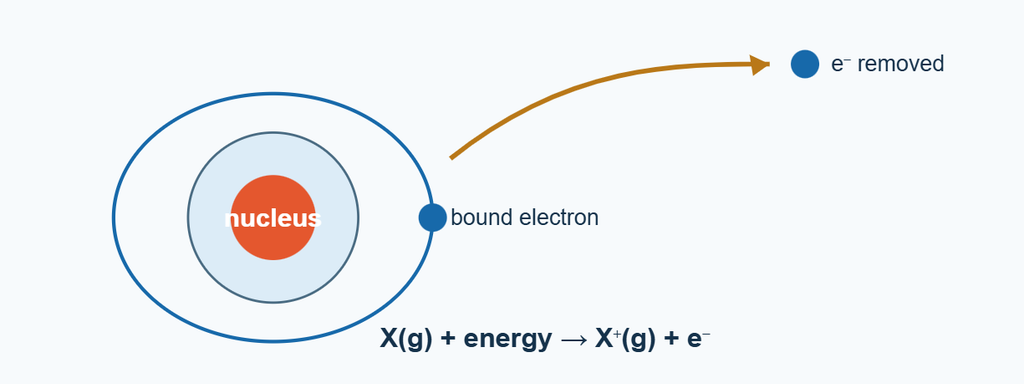
What Is Ionization Energy?
Ionization energy is the minimum energy required to remove an electron from an isolated atom or molecule in its ground state. For a neutral gaseous atom \(X\), the first ionization process is written:\[ X(g) \rightarrow X^+(g) + e^- \]
The first ionization energy, \(IE_1\), refers to removing the first electron. The second, \(IE_2\), removes an electron from the already positive ion:\[ X^+(g) \rightarrow X^{2+}(g) + e^- \]
The gaseous state matters: ionization energy is defined for isolated particles rather than atoms bonded in a solid or liquid. IUPAC’s Gold Book gives the formal definition.
Units of Ionization Energy
Ionization energy is commonly reported in:
- Electronvolts (eV) per atom, often used in atomic physics
- Kilojoules per mole (kJ/mol), often used in chemistry
These units describe the same energy on different scales. One electronvolt is the energy gained by a single elementary charge moving through a potential difference of one volt.
How the Bohr Model Illustrates Ionization
In the Bohr model, an electron in a hydrogen atom occupies a quantized energy level. The ground state has energy \(-13.6\ \text{eV}\), while a free electron infinitely far from the nucleus is assigned energy \(0\ \text{eV}\). Therefore, removing the ground-state electron from hydrogen requires \(13.6\ \text{eV}\).
For a hydrogen-like ion with just one electron, the Bohr energy levels are:\[ E_n=-\frac{13.6 Z^2}{n^2}\ \text{eV} \]
where \(Z\) is the nuclear charge and \(n\) is the principal energy-level number. This equation applies to one-electron species, such as hydrogen, singly ionized helium, or doubly ionized lithium. It is not a general formula for neutral multi-electron atoms, whose electrons also interact with and shield one another.
Successive Ionization Energies
Each successive electron is removed from an increasingly positive ion, so it generally takes more energy to remove:\[ IE_1 < IE_2 < IE_3 < \dots \]
A large jump occurs when removal begins from an inner electron shell after the outer valence electrons have been removed. This jump helps identify how many valence electrons an atom has.
For example, sodium has one electron in its outer shell. Its first ionization energy is about \(5.139\ \text{eV}\). Once that electron is removed, sodium has a stable, neon-like electron configuration; removing another electron requires much more energy. NIST lists sodium’s first ionization energy. OpenStax explains the pattern of successive ionization energies.
Factors That Affect Ionization Energy
Atomic Size
An outer electron farther from the nucleus usually experiences a weaker attraction and is easier to remove. Ionization energy therefore tends to decrease as atomic size increases.
Nuclear Charge
A greater positive charge in the nucleus generally attracts electrons more strongly, increasing the energy needed to remove one.
Shielding
Inner-shell electrons partly shield outer electrons from the nucleus. More shielding weakens the attraction felt by an outer electron and generally lowers ionization energy.
Electron Configuration
Some electron arrangements are especially stable. Removing an electron from a filled or half-filled subshell can require more energy than a simple periodic trend would suggest. As a result, ionization energy generally rises across a period and falls down a group, but there are exceptions.
Ionization Energy and Electrical Conductivity
Low ionization energy means an isolated gaseous atom can lose an electron relatively easily. This helps explain why many metals form positive ions in chemical reactions.
However, electrical conductivity in a solid metal depends on the material’s electronic band structure and the availability and movement of charge carriers. Ionization energy alone cannot predict conductivity or explain it fully. For instance, conductivity values also depend on the metal’s structure, temperature, and impurities.
Summary
Ionization energy measures the minimum energy required to remove an electron from an isolated gaseous atom or ion. It is influenced by nuclear attraction, atomic size, shielding, and electron configuration. The Bohr model gives a useful picture for hydrogen-like atoms, while the behavior of multi-electron atoms requires a more detailed quantum model.