
Circuit sources provide the voltage or current that drives a circuit. They are described as independent or dependent, and as ideal or practical. These terms describe circuit models; real batteries, generators, and electronic circuits have limits that ideal models do not.
What is an independent source?
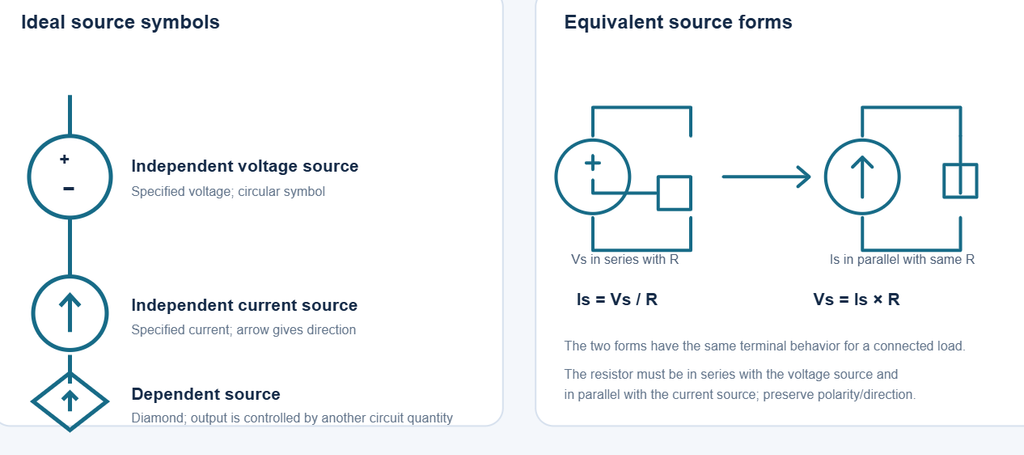
An independent source has a specified voltage or current that does not depend on another circuit variable. Its value can be constant or vary with time, such as a sinusoidal voltage or a pulse.
In schematics, an independent source is usually shown as a circle:
- A voltage source has + and − marks to show its reference polarity.
- A current source has an arrow to show its reference current direction.
Batteries and generators can often be modeled as independent sources for circuit analysis. In real circuits, their output can still change with load, temperature, and operating conditions.
What is a dependent source?
A dependent source, also called a controlled source, has an output set by another voltage or current in the circuit. It is usually drawn as a diamond.
The four common types are:
- Voltage-controlled voltage source (VCVS): Output voltage depends on a controlling voltage.
- Current-controlled voltage source (CCVS): Output voltage depends on a controlling current.
- Voltage-controlled current source (VCCS): Output current depends on a controlling voltage.
- Current-controlled current source (CCCS): Output current depends on a controlling current.
Dependent sources are useful for modeling amplifiers and semiconductor circuits. The diamond indicates a controlled source; polarity marks or an arrow show its output reference. The controlling quantity is labeled elsewhere in the schematic.
Ideal and practical sources
An ideal voltage source maintains its specified voltage regardless of the current drawn by the load. Its model has zero internal resistance.
An ideal current source maintains its specified current regardless of the voltage across its terminals. Its model has infinite internal resistance.
These models simplify calculations. Under extreme conditions, they can imply unlimited current or voltage, so they do not describe a real source operating beyond its limits.
A practical voltage source is commonly modeled as an ideal voltage source in series with internal resistance. A practical current source is modeled as an ideal current source in parallel with internal resistance. This resistance affects the output as the load changes.
How voltage and current source conversion works
A voltage source Vs in series with a resistance R can be represented by an equivalent current source Is in parallel with the same resistance:
Is = Vs / R
To convert back:
Vs = Is × R
For example, a 12 V source in series with 6 Ω is equivalent at its terminals to a 2 A current source in parallel with 6 Ω.
The resistor is essential. An ideal voltage source alone cannot be transformed into a finite ideal current source, and an ideal current source alone cannot be transformed into a finite ideal voltage source.
Source conversion applies to a source-and-resistance pair connected to the same two external terminals. The two forms produce the same terminal behavior for a connected load, although their internal circuits and power distribution differ. (UC Berkeley: Source transformations)
Finding equivalent resistance in a larger circuit
When replacing a whole linear network with an equivalent Thévenin or Norton circuit, calculate the resistance looking into the chosen terminals. A common method is to deactivate independent sources: replace ideal voltage sources with short circuits and ideal current sources with open circuits.
Keep dependent sources active. If they are present, a test source may be needed to find the equivalent resistance. This network-level calculation is different from converting a single source with its series or parallel resistor.
Key points
Independent sources have a specified output; dependent sources are controlled by another circuit quantity. Ideal sources simplify analysis, while practical models include internal resistance and operating limits. To convert a source, use Is = Vs/R or Vs = Is × R, keep the same resistance, and preserve the polarity or current direction.